
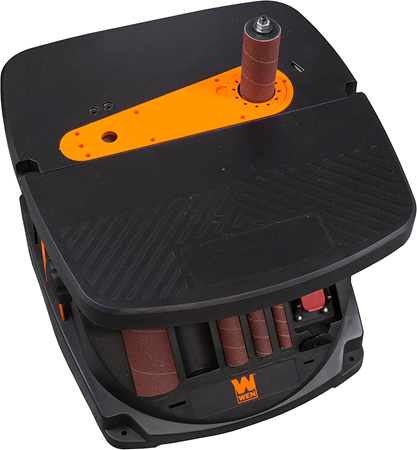
A spindle sander or oscillating sander is a tool to me that is a must have for any small shop. When I was just out of high school I worked in a production wood shop where I spent hours on both a spindle sander and an oscillating belt sander. I became very proficient on both of them and I knew that I would need them at home. Just recently I purchased the Wen Oscillating belt sander, spindle sander combo tool and have put it to good use shaping wing rib templates for an RC airplane project and a small decorative wall cabinet among other things. The oscillating sander is a standard stop for most projects in between the cut out and routing stage. The oscillating feature of the tools will help remove material as well as utilize more for of the belt and spindle.
I wanted a spindle sander that would handle different size drums for varying applications. I wanted to have different grits readily available as well. I typically am using a 100 grit or so but sometimes I want a something a little more aggressive. I also wanted enough power to lean on the machine when need be. The table size didn’t have to be huge but did have to be large enough to stabilize the work. I found that with several sanders but what really caught my eye were the spindle sanders that had a belt option on the same unit. I would rather have both a spindle and a belt sander if I could but space is somewhat tight so I leaned towards the Wen which had both the oscillating spindle and the oscillating belt option. There are other brands very similar including Rigid and others. The RPM on the Wen is listed at 2000 and the Rigid claims 1750. When you compare the amps, the Rigid shows 5 amps and the Wen shows 3.5 amps. Construction on both is similar with tilting beds for bevel sanding. The Rigid is a bit more money and a little bigger. Both have several different spindle sizes. I think either one would serve you well. I went with the Wen and it has had enough power to make me happy. Changing between spindle sizes with the Wen is simple with the onboard tools and spindles as well as different size throat plates for the different size spindles and the belt. Changing to the belt is easy as well. I am going to be mounting mine on a flip table so I will need to make storage for the accessories.
One of the first things I did with my spindle sander was install the belt. I was working on a small RC airplane and made two wing templates out of thin plywood and then stacked balsa blanks between the tool and sanded them down between the templates. Perfect wing ribs, really fast. I typically have the spindle on the tool, usually the mid-size one. I use it to smooth out shelf brackets and other curved edge cut out pieces. A spindle sander is especially appreciated here as I typically use my jig saw and blade flex can add a slight angle in a cut. The spindle sander can square it up nicely. The belt sander is nice for cleaning up edge cuts all though if you have a steady hand, you can do a pretty good job with the spindle. I still sharpen my pencil once and while on my sander but I quit doing my nails!
My spindle sander/oscillating sander is a tool that I used on a regular basis and I think you would find it very useful in your shop. It will improve the quality of your projects and really is simple to operate. When you order the, consider adding a few different grits of sandpaper, both for the spindles and the belt. Another little accessory is a belt eraser to clean the sap out of the grit. This is especially helpful with woods like pine.
What I was Looking For In A Spindle Sander
Uses For The Spindle Sander
To Wrap It Up

